

Most business strategies look great on paper and collapse in practice. Fewer than 25% of strategic projects get completed across the majority of organizations, which means the problem is rarely the idea itself. It's the process. For business owners and entrepreneurs operating in Europe and Morocco, where market conditions shift fast and competition is fierce, having a repeatable, structured approach to strategy is not optional. This guide walks you through every phase, from scanning your environment to sustaining momentum, so you can build a strategy that actually delivers growth.
Table of Contents
- What is the business strategy process?
- Preparing to build your strategy: Tools, frameworks, and common requirements
- Step-by-step: Building and executing your strategy
- Pitfalls, edge cases, and tips for Europe and Morocco
- Evaluating, adapting, and sustaining your strategy over time
- Take your strategic planning further with WasetHelp
- Frequently asked questions
Key Takeaways
| Point | Details |
|---|---|
| Follow a structured process | Break down strategy into scanning, analysis, formulation, implementation, and evaluation for reliable results. |
| Prioritize simplicity and ownership | Lean plans with clear owners outperform complex, unfocused strategies. |
| Adapt for your business environment | Iterate your plan and emphasize agility to remain competitive in Europe and Morocco. |
| Measure and review regularly | Use clear KPIs and adapt your strategy every quarter to stay on course. |
What is the business strategy process?
A business strategy process is the structured sequence your organization follows to move from where you are today to where you want to be. It's not a single document or a one-time meeting. It's a repeatable system that connects your goals to your actions and your actions to measurable results.
The strategy process breakdown typically follows five core phases: environmental scanning, internal audit, strategy formulation, implementation, and evaluation. Each phase feeds into the next, creating a loop rather than a straight line. That loop is what separates businesses that adapt from businesses that stall.
For entrepreneurs in Morocco and across Europe, this structure matters even more. Regulatory environments, consumer behavior, and competitive dynamics vary significantly across markets. A process that works in Paris may need real adjustment for Casablanca. The framework gives you a consistent foundation while leaving room for local adaptation.
Here's a quick overview of the five core steps and what each one is designed to accomplish:
| Strategy step | Main objective |
|---|---|
| Environmental scanning | Identify external opportunities and threats |
| Internal audit | Assess your strengths, weaknesses, and resources |
| Strategy formulation | Define goals, priorities, and competitive positioning |
| Implementation | Assign ownership, allocate resources, and execute |
| Evaluation | Measure results, adapt, and improve continuously |
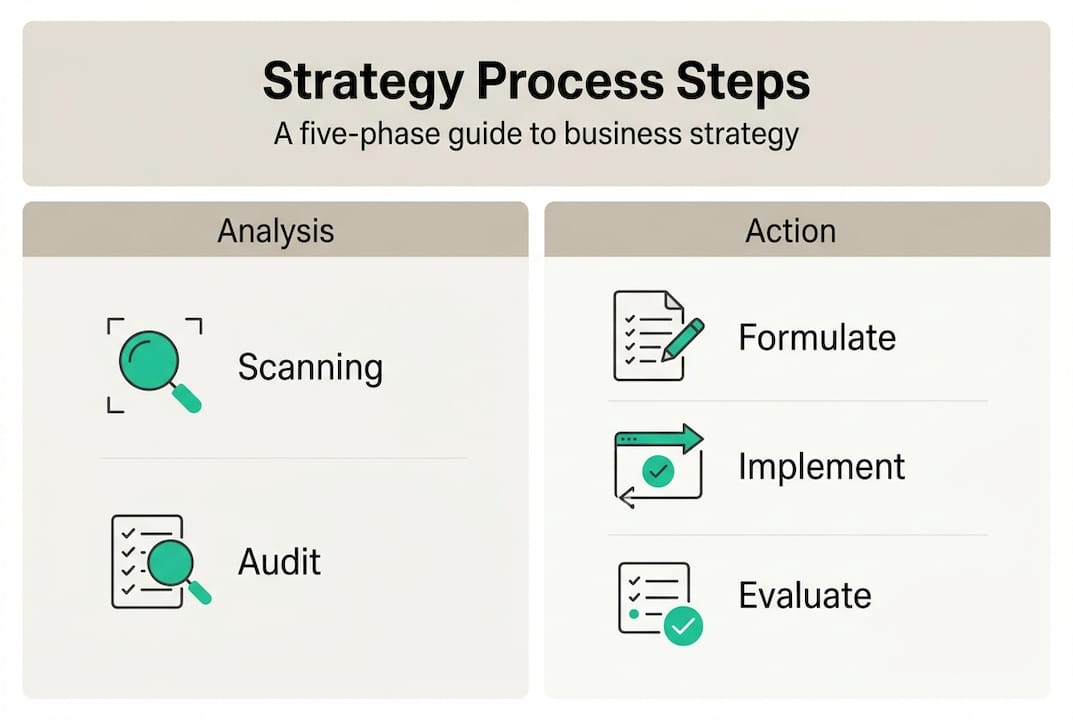
Over 80% of organizations struggle to execute strategy effectively. The table above shows why: each step requires distinct thinking and distinct tools. Skipping one creates a gap that compounds over time.
Preparing to build your strategy: Tools, frameworks, and common requirements
With the process outlined, preparation is the foundation of effective strategy. Before you write a single goal, you need the right inputs. Walking into a strategy session without data is like navigating without a map. You might move fast, but you won't know where you're going.
Start by gathering four categories of information: your financial performance over the last 12 to 24 months, current market research for your industry and region, a clear picture of your top three competitors, and an honest assessment of your digital readiness. That last one matters more than most owners expect, especially in markets where digital adoption is accelerating.

Once you have your data, choose a framework to organize your thinking. Key methodologies include the Business Model Canvas, Balanced Scorecard, OKRs (Objectives and Key Results), Hoshin Kanri, and Blue Ocean Strategy. Each serves a different purpose:
| Framework | Best for | When to use it |
|---|---|---|
| Business Model Canvas | Startups, pivots | Early stage or major repositioning |
| Balanced Scorecard | Established businesses | Multi-department alignment and KPI tracking |
| OKRs | Agile teams | Fast-moving environments with quarterly cycles |
| Blue Ocean Strategy | Market differentiation | When you want to create uncontested market space |
Here's what you need before you start:
- At least 12 months of financial data (revenue, margins, cash flow)
- A competitor analysis covering pricing, positioning, and digital presence
- Customer feedback or survey data from the last 6 months
- A clear understanding of your team's current capacity
- Access to startup strategy tools if you're in early growth mode
Pro Tip: Pick one or two frameworks maximum. Using three or more creates confusion and slows decision-making. The Business Model Canvas paired with OKRs covers most scenarios for growing businesses in Europe and Morocco.
Step-by-step: Building and executing your strategy
Once your foundation is ready, follow this proven sequence for reliable results. This is where most owners either gain real traction or lose momentum. The difference usually comes down to discipline and specificity.
-
Environmental scanning. Map your external landscape using a PESTLE analysis (Political, Economic, Social, Technological, Legal, Environmental). For Morocco, pay close attention to regulatory shifts and regional trade agreements. For European markets, factor in EU policy changes and digital compliance requirements.
-
Internal audit. Run a SWOT analysis (Strengths, Weaknesses, Opportunities, Threats) with your leadership team. Be brutally honest. The goal is clarity, not comfort. Identify your top three competitive advantages and your two biggest operational gaps.
-
Strategy formulation. Translate your audit findings into specific, measurable objectives. Avoid vague goals like "grow revenue." Instead, write "increase monthly recurring revenue by 20% in the next two quarters by expanding into the B2B segment."
-
Implementation. Assign a named owner to every goal. Not a team, not a department. One person. Assigning clear ownership boosts completion rates by 12.8%. Pair each goal with a budget, a timeline, and a weekly check-in rhythm.
-
Evaluation. Set your KPIs before you launch, not after. Review them monthly and run a full strategic review every quarter. High-performing organizations use lean plans with 5 to 9 goals and operate in cycles of roughly 13 to 14 months.
"Assigning clear ownership boosts strategy completion by 12.8%. One owner per goal is not a preference. It's a performance driver."
Pro Tip: Limit your main strategic goals to three to five. More than that and your team loses focus. Review progress every quarter, not just at year-end. Annual reviews are too slow for the pace of change in most European and Moroccan markets.
Pitfalls, edge cases, and tips for Europe and Morocco
Even the best-designed processes face challenges and exceptions. Here's how to adapt and win. The most common reason strategies fail is not a bad idea. It's a predictable set of execution mistakes that most owners repeat without realizing it.
Watch out for these pitfalls:
- Overcomplicating the plan. A 40-page strategy document is not a strategy. It's a liability. If your team can't summarize the plan in two minutes, it's too complex.
- Focusing only on internal optimization. Improving internal processes while ignoring market shifts is a slow way to fall behind. External scanning must be ongoing, not a once-a-year exercise.
- Ignoring digital literacy gaps. In both Morocco and Europe, digital transformation is reshaping competitive dynamics. A strategy that doesn't account for your team's digital capabilities will hit a wall fast.
- Treating strategy as a static document. Markets move. Your strategy must move with them.
- Skipping stakeholder alignment. If your leadership team isn't aligned on priorities, execution breaks down at the first obstacle.
Traditional planning fails in high-velocity environments, and strategic agility in Morocco has proven to be a decisive competitive advantage. Intelcia, a Moroccan multinational, scaled across multiple continents by building agility directly into its strategic process. Rather than locking into rigid annual plans, the company built short review cycles and cross-functional decision-making into its operating model. The result was faster market entry and stronger resilience when conditions shifted.
For businesses in Morocco navigating institutional complexity, or European firms dealing with regulatory fragmentation, the lesson is the same: build flexibility into your process from day one.
Evaluating, adapting, and sustaining your strategy over time
With strategy in motion, ongoing evaluation keeps you on track. Most owners treat evaluation as the final step. It's actually the most important ongoing habit. A strategy without regular review is just a wish list.
Evaluation via KPIs and adaptation is a core part of the business strategy process, not an optional add-on. Set your key performance indicators before you launch each phase. Track them monthly. Adjust when the data tells you to, not when it feels comfortable.
Watch for these red flags that signal your strategy needs adjustment:
- Revenue growth is flat for two consecutive quarters despite execution
- Team members can't articulate the company's top three priorities
- New competitors are gaining share in your core market
- Customer acquisition costs are rising without a corresponding increase in lifetime value
- Your KPIs haven't changed in over 12 months
Here's a practical evaluation framework to run every quarter:
| Evaluation question | Action step |
|---|---|
| Are we hitting our KPIs? | Identify the top gap and assign a fix owner |
| Has the market shifted? | Update your environmental scan |
| Is our team aligned? | Run a 30-minute alignment session with leadership |
| Are our goals still relevant? | Revise or retire goals that no longer serve growth |
| What did we learn this quarter? | Document insights and apply them to the next cycle |
For adapting strategy for change, the key mindset shift is treating your strategy as a living system. The businesses that sustain growth over time are not the ones with the best initial plan. They're the ones that learn fastest and adjust most consistently.
Take your strategic planning further with WasetHelp
Putting a structured strategy process in place takes more than a good framework. It takes the right support, the right tools, and a team that understands your market. At WasetHelp, we work directly with business owners and entrepreneurs across Europe and Morocco to build strategies that are clear, executable, and built for real growth.
From business strategy consulting and digital advertising to SEO, automation, and client loyalty systems, our services are designed to support every phase of your strategic process. Whether you're starting from scratch or refining an existing plan, we can help you move faster and smarter. See our plans to find the right fit for your business, or create your account today and take the first step toward a strategy that actually works.
Frequently asked questions
What are the key steps in the business strategy process?
The core steps are environmental scanning, internal audit, strategy formulation, implementation, and evaluation. Each phase builds on the previous one and feeds back into the cycle.
Which strategic frameworks are best for small businesses or startups?
Lean tools like the Business Model Canvas and OKRs work best for startups due to their simplicity and focus. They're easy to update as your business evolves, which matters more than comprehensiveness at early stages.
Why do most business strategies fail?
Most fail from overcomplexity, lack of ownership, or an inability to adapt as the market changes. Fewer than 25% of strategic projects get completed in most organizations, which points to execution gaps rather than planning gaps.
How often should a business strategy be reviewed?
Review your strategy at least quarterly to stay aligned with market changes. Annual reviews are too infrequent for the pace of change most businesses face in 2026.
How can agility benefit businesses in Europe and Morocco?
Agility allows companies to adapt quickly to complex or shifting institutional environments. Moroccan MNCs expanding into Europe and Africa have demonstrated that strategic agility directly drives international competitiveness and resilience.